 VapeWholesaleHub
Atomizers Compliance Basics for Importers — the Buying Desk
Retailers rarely lose money on atomizers because of price. They lose money because the first container was bought on a photograph. This page walks through what actually matters when you source atomizers at scale, written from the buying desk rather than the marketing department.
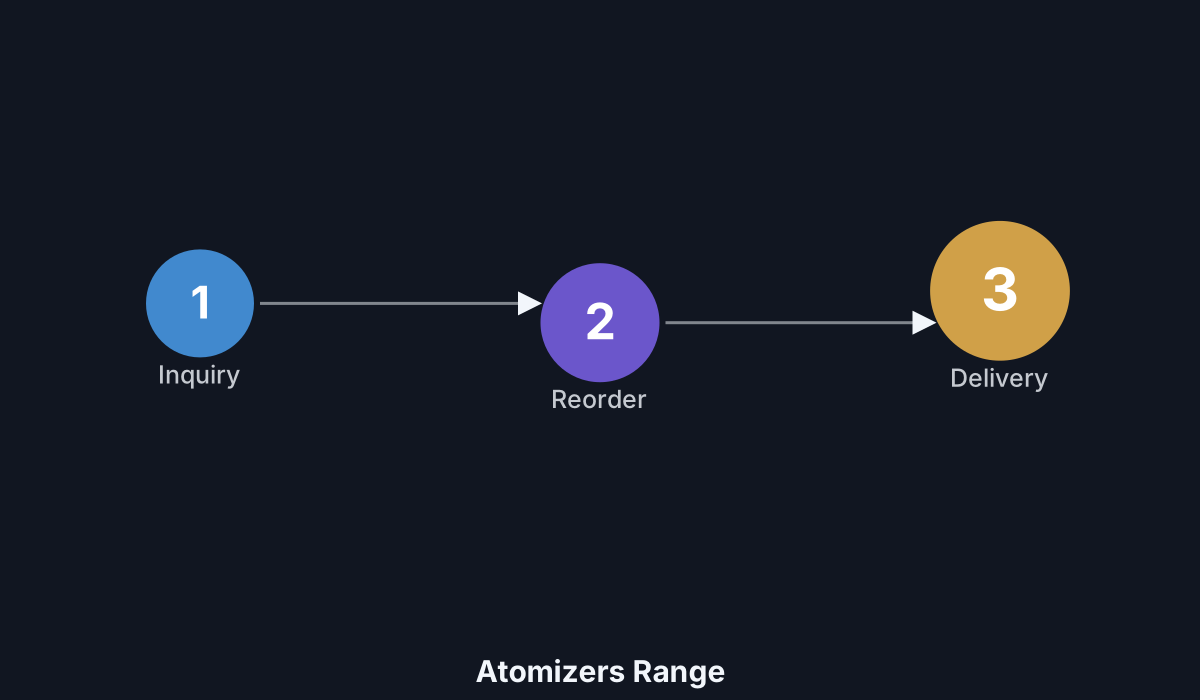
The Specification That Matters
Where possible, tie part of the atomizers payment to inspection against the written spec. It focuses attention on the numbers rather than on the relationship.
Two specifications that matter more than buyers expect: the seal integrity after a drop test and the consistency of the draw from first use to last. Both are measurable before you commit to volume.
| Product category | Refillable kit |
|---|---|
| Resistance band | 1.2 - 1.4 ohm |
| Capacity tolerance | +/- 5% |
| Puff count method | Machine cycle 2s on / 18s off |
| Master carton | 100 units |
| Carton weight | 12.1 kg |
| Shelf life | 12 months |
| Storage | 15-25 C, dry, away from direct light |
Inspection Before Dispatch
The defect rate that matters is the one your customer experiences, not the one the factory reports. Bridge that gap by inspecting the way a customer would open the box, not the way a line worker packs it.
- Model landed cost, not ex-works price, when comparing quotes.
- Start with a mixed carton and let your own sell-through decide.
- Agree the tolerance band in writing before approving artwork.
- Plan the switch from air to sea freight before you need it.
- Check carton dimensions against your freight quote before confirming.
Positioning Atomizers on Your Shelf
Atomizers rewards retailers who can explain it in one sentence. If your team needs a paragraph, the range is too complicated for the space it occupies.
Pricing and Margin
Margin on atomizers is rarely lost at the till. It is lost through dead stock, returns and emergency air freight. A slightly higher landed cost with predictable lead time usually beats the cheapest quote on the spreadsheet.
Indicative reference points for planning purposes: entry tier from USD 0.87 per unit at 1000 units, mid tier at USD 1.46, and volume tier at USD 0.53 for full container quantities. These figures move with specification, packaging and freight, so treat them as a shape rather than a quote.
Market Signals
The most durable atomizers lines over the last few years have been unglamorous and consistent. Novelty sells once; reliability sells every month.
Logistics That Protect Margin
Track atomizers landed cost per unit as a running number, including duty and local delivery. It is the only figure that tells you whether a supplier change actually improved anything.
Practical Checklist
- Keep sealed retained samples from every production batch.
- Ask how the factory measures puff count, then compare like with like.
- Check carton dimensions against your freight quote before confirming.
- Rotate stock by batch code rather than by delivery date.
- Start with a mixed carton and let your own sell-through decide.
- Model landed cost, not ex-works price, when comparing quotes.
Frequently Asked Questions
What if a batch does not match the sample?
Keep the retained samples from the approval stage. If a delivered batch measurably differs, we compare against the retained set and resolve it against the production record. This is why we insist on sealed retained units from every run.
Do you provide compliance documents?
Every shipment leaves with the documentation set relevant to your market, including batch records and test reports where required. Your local rules still determine what you must file, so confirm those with your broker before import.
How do you handle a short shipment?
Cartons are counted and weighed before dispatch and the figures are shared with you. If something is short on arrival, the packing record and the carrier documentation are both available, which keeps the claim straightforward.
What if I only need a small first order?
That is normal and sensible. A mixed carton lets you test atomizers in your own market before committing to a production run, and the specification you approve at that stage carries through to larger orders unchanged.
How long does a atomizers order take to arrive?
Production typically takes ten to eighteen working days after artwork approval, and transit depends on the method you choose. Air express is fastest, sea freight is cheapest at volume. We confirm both at quotation so there is no surprise later.
Next Step
Nobody wins when a first order is too large to learn from. Start with a mixed carton, check how it moves in your own market, then scale the lines that earned the shelf space.
Related Reading
- Atomizers Seasonal Peaks and Stock Cover — Wholesale Clubs
- Atomizers Product Testing Laboratories Explained — Cross-Border Trade
- Atomizers Bundle Pricing That Moves Older Stock — Online Sellers
- Atomizers Insurance and Cargo Cover Explained — Warehouse Teams
- Atomizers Tolerance Bands That Hold Up in Production — Before Your Next Order
- Atomizers Handling Product Recalls Professionally — Low Minimum Quantities