 VapeWholesaleHub
Atomizers Trade Show Buying Tactics — Three Price Tiers
A atomizers programme fails in predictable ways: a specification nobody wrote down, a sample nobody retained, and a lead time nobody stress tested. Here is how to close those three gaps before they cost you a container.
Positioning Atomizers on Your Shelf
Decide early whether atomizers is a traffic driver or a margin line in your store. The answer changes how you price it, where you place it and how hard you push it at the counter.
Pricing and Margin
Watch the atomizers price you pay over a year rather than per order. Factories respond well to visible volume, and a quarterly review is usually worth more than a hard negotiation each time.
The cheapest atomizers quote is rarely the cheapest outcome. Add freight, defect handling, delay risk and the staff time spent chasing, then compare again. The ranking often changes.
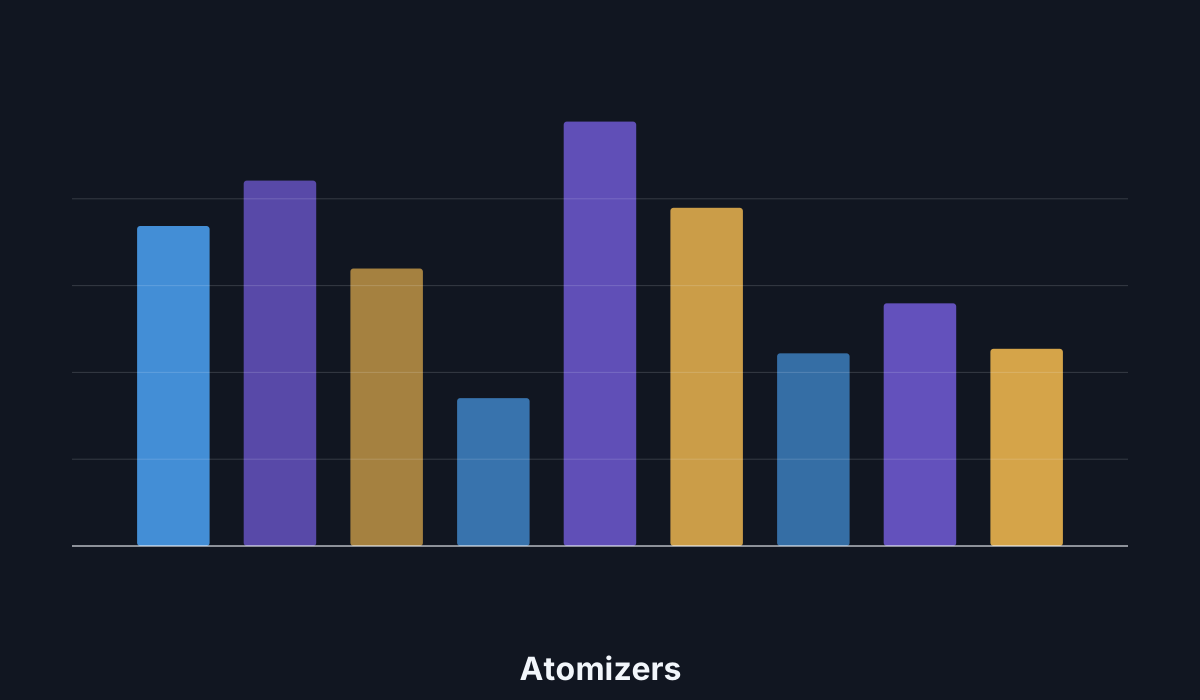
Indicative reference points for planning purposes: entry tier from USD 1.77 per unit at 1000 units, mid tier at USD 1.70, and volume tier at USD 0.51 for full container quantities. These figures move with specification, packaging and freight, so treat them as a shape rather than a quote.
Turning Atomizers Into Repeats
Online, shoot atomizers at a consistent scale across the range. Customers compare by eye, and inconsistent product photography creates returns that have nothing to do with the product.
Keep the atomizers range tidy. A half empty shelf reads as a dying line, and customers interpret it that way faster than any signage can correct.
Inspection Before Dispatch
The cheapest quality control step is a retained sample. Keeping three sealed units from every atomizers batch costs almost nothing and turns any dispute into a simple comparison instead of an argument over photographs.
Incoming inspection for atomizers is not about opening boxes at random. We weigh a sample of cartons, check batch codes against the production record, run a draw resistance measurement, and log the results so that a complaint three months later can be traced to a specific run.
- Agree the tolerance band in writing before approving artwork.
- Write the complaint threshold into the order terms.
- Ask how the factory measures puff count, then compare like with like.
- Start with a mixed carton and let your own sell-through decide.
- Plan the switch from air to sea freight before you need it.
What to Fix Before Approving Atomizers
When we write a atomizers specification with a distributor, we fix four things first: the resistance band, the liquid capacity tolerance, the puff count methodology and the packaging master carton. Everything else can flex without changing the customer experience.
Revisit the atomizers specification after every third order. Small improvements compound, and factories take a buyer more seriously when the document has clearly been used.
| Product category | Open system |
|---|---|
| Resistance band | 0.6 - 0.8 ohm |
| Capacity tolerance | +/- 2% |
| Puff count method | Machine cycle 3s on / 27s off |
| Master carton | 120 units |
| Carton weight | 3.3 kg |
| Shelf life | 18 months |
| Storage | 15-25 C, dry, away from direct light |
Practical Checklist
- Plan the switch from air to sea freight before you need it.
- Confirm the current customs classification with your own broker.
- Start with a mixed carton and let your own sell-through decide.
- Keep sealed retained samples from every production batch.
- Check carton dimensions against your freight quote before confirming.
- Agree the tolerance band in writing before approving artwork.
Frequently Asked Questions
Can the packaging be customised?
Yes. Most atomizers programmes use private label packaging once volumes justify the printing plate. We supply dielines, check your artwork for print issues and hold approved files so reorders need no new setup.
Do you hold stock for regular customers?
For established programmes we can reserve production slots and, in some cases, hold finished atomizers stock against a forecast. It removes most of the lead time risk from a reorder and is worth discussing once volumes are stable.
Can you match an existing product I already sell?
Often yes, provided we can measure it properly. Send a physical sample and we will report back on what can be matched, what will differ slightly, and why. An honest gap is more useful than a vague promise.
Do you provide compliance documents?
Every shipment leaves with the documentation set relevant to your market, including batch records and test reports where required. Your local rules still determine what you must file, so confirm those with your broker before import.
How do you handle a short shipment?
Cartons are counted and weighed before dispatch and the figures are shared with you. If something is short on arrival, the packing record and the carrier documentation are both available, which keeps the claim straightforward.
Next Step
Send us your current atomizers specification even if you are not planning to move suppliers. A second read of a document you use every month is usually worth the ten minutes.
Related Reading
- Atomizers Planogram Basics for Wall Displays — Three Price Tiers
- What a Atomizers Production Slot Really Means — Warehouse Teams
- Atomizers Market Entry Checklist for New Territories — Small Batch Buyers
- Atomizers Child Resistant Closure Considerations — Convenience Retail
- Setting Minimum Order Quantities for Atomizers — the Middle East
- Sustainability and Take Back Programmes for Atomizers — Regional Distributors